Home >> News >> Industry News
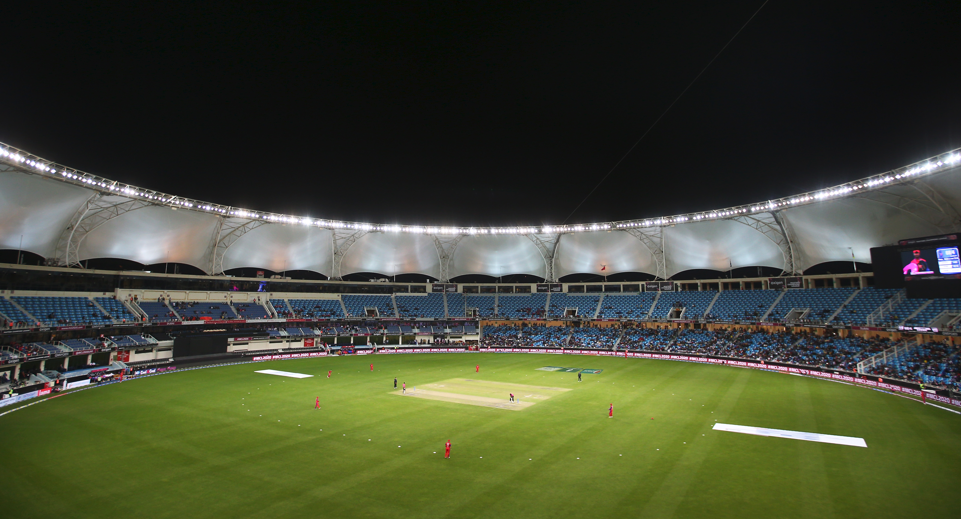
Ultra high power LED flood lights are high-wattage systems capable of producing 80,000+ lumens in a controlled beam. Available from 600W to 2000W, they are engineered for large-area lighting and long-range projection. Mounted on high masts, they can be aimed downward to confine light to the design area, control spill light, and reduce glare. This makes them ideal for stadiums, airports, container yards, and other expansive or distant luminous zones.
Traditional high power flood lighting, especially metal halide systems, is a huge drain on resources. Metal halide lamps—a type of high intensity discharge (HID) source—were once the default for high power systems. They offer high wattages and decent color rendering, but in energy-intensive applications they have lost ground due to ever-tightening energy code compliance, primarily because of their low lighting application efficiency (LAE).
Compared with LEDs, metal halide lighting offers lower source efficiency and leaves little room to improve optical delivery, spectral efficiency, and intensity effectiveness. Their lumen output is sensitive to operating position, making them disadvantageous in floodlighting where optical aiming is fundamental. They also require long warm-up and restrike times, age quickly under frequent switching, and have restrictive dimming capabilities. These drawbacks prevent energy savings from lighting control strategies, and maintenance is a constant, costly worry.
High wattage lamps have a short life of around 3000 hours. At roughly 1000 hours, they exhibit unacceptable lumen depreciation. Group re-lamping is required at the end of bulb life to avoid catastrophic envelope failure—bulb explosion.

Impressive energy savings, extremely long service life, virtually maintenance-free operation, and high lighting quality are well-known benefits of LED lighting. LED lighting opens the door to holistic optimization of energy consumption beyond improvements to light source efficiency.
Effective optical design exploiting the directional nature of LEDs can achieve optical efficiency greater than 90%, whereas HID fixtures often lose more than 30% of source lumens within the fixture. Only with high utilization efficiency does the high luminous efficacy of a light source make sense.
Accompanying this is effective light distribution. The light emitting surface (LES) of an LED light engine can be customized to a specific application, which, together with high-performance secondary optics, enables high uniformity with minimal waste of lumens. As a result, the luminaire efficacy of ultra high power LED flood lights is far ahead of HID fixtures.
With instantaneous dimming and on/off capabilities, LEDs unlock the energy savings potential of lighting controls. LED flood lights incorporating sensors, intelligence, and network connectivity provide unprecedented controllability. Their long useful lifetime and reduced maintenance costs generate another payback advantage.
Though superior energy efficiency and long life expectancy of LEDs are proven facts, an LED flood light is in many ways more complex than a traditional lighting fixture. LEDs are characteristically limited to operation under specified ranges for electrical power, temperature, humidity, and other parameters. The efficacy, reliability, and other performance metrics of an LED or group of LEDs are tightly interdependent upon driver circuitry, thermal management system, and optical system.
To achieve optimal performance, select or specify a combination of highly compatible LED packages, heat sink, driver, and controls that meet project requirements. Each component must be subjected to extensive design qualification so all components work in unison to deliver intended value.
Most ultra high power LED flood lights are modular systems using different numbers of LED light engines to provide scalability, versatility, flexibility, and ease of maintenance. Fully integrated systems are also available, usually in lower wattages and optimized for a particular application.
To produce extraordinarily high output, the flux density and drive current of LEDs are necessarily very high. The high-power LED architecture therefore calls for LEDs capable of high operating temperatures.
High power LEDs have a highly dependable construction featuring a ceramic substrate that is immune to thermal and photo degradation and provides a high-efficiency thermal path to conduct heat away from the active region. The majority of semiconductor dies used to create high power packages are constructed from heteroepitaxial growth of gallium nitride (GaN) on sapphire substrates. However, high power LEDs that grow GaN on silicon carbide (SiC) substrates offer significant advantages in lumen output and device longevity because the GaN-on-SiC design creates fewer dislocations and yields more uniform GaN layers.
Regardless of technology platform, the performance of the phosphor down-converter applied directly on the LED chip is vital. It must provide the specified spectral behavior defining the LED's color characteristics while providing high-efficiency down-conversion and resisting high thermal stresses. The color rendering index (CRI) of LEDs used in ultra high power luminaires falls in the range of 70s to 80s, and the correlated color temperature (CCT) is usually 4000K or 5000K.
One of the most challenging issues when operating an ultra high power LED flood light is thermal management. Despite their significantly higher light conversion efficiency over HID, incandescent, and fluorescent lamps, LEDs throw away more than 50% of electrical input power, dissipated as heat within the semiconductor package. In a 1000-watt system, more than 500 watts—typically in excess of 600 watts—of electrical power is converted into heat.
If allowed to accumulate, this heat can raise operating temperature and lead to irreversible damage. Overheating accelerates the creation of crystalline defects at the interface of the substrate and epitaxial layer and even poses risks of thermal runaway. Phosphors also degrade rapidly under high thermal stresses.
The amount of heat that can be removed largely depends on the design of the thermal path from the die to the air surrounding the luminaire. Thermal resistance along the entire path from LEDs to luminaire housing should be minimized using highly thermal-conductive materials. Implementation of a robust thermal path calls for high-reliability interconnects, metal core PCBs (MCPCBs), and thermal interface materials (TIMs) with low thermal resistance.
The heat sink is the last and most crucial part of the thermal path, serving to conduct heat away from LEDs and dissipate it into ambient air via convection and radiation. It is typically made from die cast, extruded, or cold forged aluminum, formed in one piece with the housing to maximize thermal performance.
Ultra high power LED flood lights are primarily designed to be cooled through natural convection because of the reliability of passive heat sinks. An effective aerodynamic design that maximizes the convection heat transfer coefficient is also important. Heat pipes may be added to facilitate heat dissipation or spreading.
The LED driver that operates constant current LEDs must deliver high efficiency, high reliability, and robust protection against overvoltage, short circuit, overload, overtemperature, and other abnormal conditions. An ultra high power LED flood light may incorporate a driver with multiple output channels or a set of drivers that individually operate each modular light engine.
The driver circuit should convert AC line voltage into prescribed DC power while shaping the AC input waveform to achieve required power factor and low total harmonic distortion (THD). Higher power LED drivers are typically designed as two-stage switching power supplies that include active power factor correction (PFC) and a DC-DC converter.
Despite increased complexity, two-stage SMPS drivers provide higher efficiency power conversion than single-stage systems at higher power levels. Other advantages include higher voltage operation, wider input voltage and dimming ranges, higher surge capability, lower EMI signature, and less line frequency related flicker. Higher power LED drivers must have elevated surge immunity and transient voltage suppression to safeguard reliable operation.
An LED driver can come with different levels of integration with controls, sensors, and connectivity for adaptive and/or smart lighting control. Common control protocols include 1-10V, DALI, ZigBee, Z-Wave, and Bluetooth Mesh.
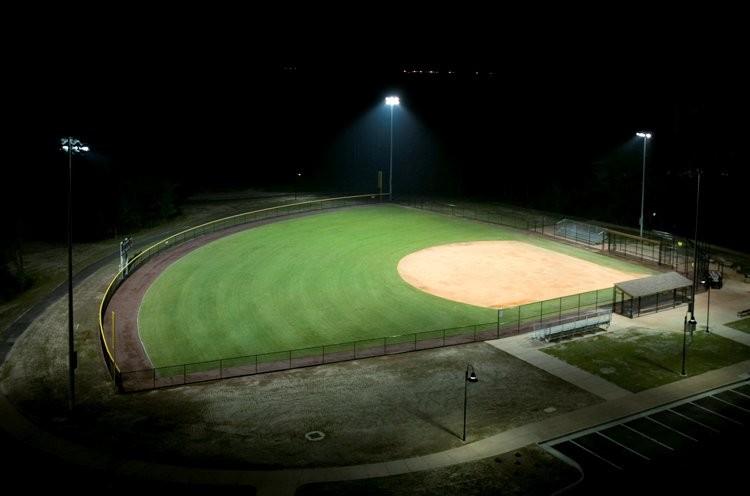
The optical system that modifies, adjusts, and helps optimize distribution of emitted light is just as important as the light source, thermal management system, and driver. An inefficient optical design can waste a tremendous amount of light emitted by LEDs of a high wattage system.
LED flood lights can be designed to produce a wide array of beams, with light distributions ranging from tight spot to wide flood (NEMA beam type 1 to 7) and radiation patterns in axial symmetry or asymmetry. Control of light distribution is achieved with reflectors, lenses, or a combination of them.
Secondary optics for LEDs are commonly designed to provide package-level optical regulation. Oftentimes, a reflector system comprised of an array of small reflectors, rather than a large reflector over the entire LES, is used to control the entire initial distribution from LED sources. To produce smooth NEMA type 1, 2, or 3 beams, the total internal reflecting (TIR) optic that combines the best of both a reflector and a lens is the optimum solution. However, TIR lenses are often made from acrylic or polycarbonate, which can be thermally challenged in high power applications.
Ultra high power LED flood lights need to be designed to withstand the environment in which they are installed. To prevent moisture, dust, contaminants, and insects from entering the luminaire, it's suggested to seal the luminaire to a rating of IP65 or better.
The optical assembly is usually protected by a tempered glass lens with full circumference form-in-place silicone gasket. This enclosure should be vented with a microporous membrane breather which can rapidly equalize pressure differentials arising from temperature cycling and simultaneously provides a durable barrier against liquid, dust, dirt, and other contaminants.
Ultra high power LED flood lights represent the pinnacle of modern large-area illumination. By combining high luminous output, superior optical efficiency, advanced thermal management, and intelligent control, they outperform traditional HID systems in energy savings, longevity, maintenance costs, and lighting quality. For stadiums, airports, container yards, and other expansive or distant luminous zones, the luminous monster is not just an upgrade—it is the new standard.
Previous: None