Home >> News >> Industry News
Parking lot lights are area lighting systems that create accurate and comfortable visibility of possible hazards at night to safeguard, facilitate, and encourage vehicular and pedestrian traffic. A parking lot, also known as a car park or car lot, is an outdoor area assigned for parking. It is a special adjunct to a public facility, business establishment or residential community. In their most common form, parking lots are a gazillion square feet of asphalt or concrete paving spaces next to shopping malls, retail shopping plazas, office buildings, sports stadiums, business complexes, airports, theme parks, megachurches, restaurants, etc.
Because parking lots serve a mix of pedestrian and vehicular traffic, visibility is crucial in these intense driving environments. Parking lot lighting must enable drivers to clearly see pedestrians, particularly in the visual periphery, provide pedestrians an illuminated environment for detection and identification of tripping hazards and evaluation of personal safety, and reinforce a sense of personal safety and security.
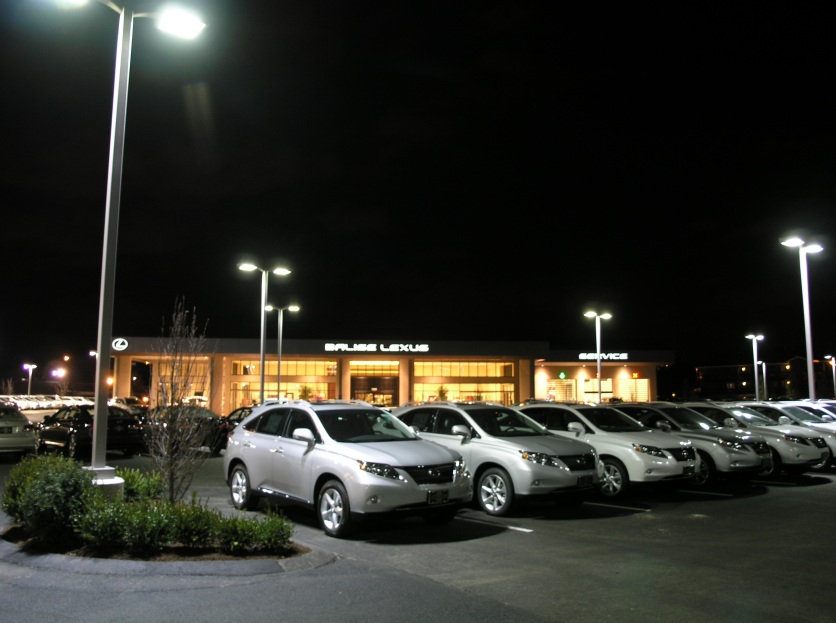
Parking lot lighting design involves systematic consideration and integration of variable elements that include illuminance required for drivers to observe obstacles and avoid accidents, visibility and security needs of pedestrians walking to or from their vehicles, energy use, maintenance requirements, site conditions, lighting zones, mounting methods, aesthetics, environmental issues and constraints. The primary objective of parking lot lighting is to address the critical safety requirements by providing visibility for drivers and pedestrians. Parking lot lighting communicates information about the nighttime environment to both groups of viewers by creating object luminance through an optimized combination of horizontal and vertical illuminance.
Object detection is dependent on adequate luminance contrast between the object and its background. The minimum illuminance metrics must ensure driver/pedestrian perception-reaction and vehicle stopping distances at which an object may be detected to avoid impact. The detection distance comes down to the speed at which the vehicle or pedestrian is moving, the perception-reaction time required to initiate evasive action, and the distance required to execute the evasive action. Typically, the total distance required for perception-reaction and vehicle stopping is 8 to 13 meters for moving vehicles and 2 to 3 meters for a pedestrian.
The illuminance method of parking lot lighting design determines the amount of light incident on the pavement surface and on vertical surfaces from parking lot lights. For parking lots with concrete pavement, a minimum horizontal illuminance of 10 flux should be maintained. The minimum horizontal illuminance for parking facilities with asphalt pavement is 5 flux. Vertical illumination is important as well because it allows visibility of vertical objects. The minimum vertical illuminance for parking lot lighting should be half of the minimum horizontal illuminance.
A maximum-to-minimum illuminance of no greater than 15:1 should be specified to ensure a driver or a pedestrian will be able to detect an object in both the brightest and darkest areas within the field of view. Poor uniformity of illuminance also has large safety implications due to the adaptation effects. Large changes in retinal illumination from cone photoreceptor operation to rod photoreceptor operation take tens of minutes. When the visual system is not completely adapted to the prevailing retinal illumination during this period, the visual capabilities are limited. Transition from a bright environment (photopic vision) or a very dark environment (scotopic vision) to one of very different luminance will cause a transitional loss of visual acuity. Parking lot lighting should create uniform illumination across the site and smooth transitions from light to dark at the entry and exit points.
A collection of outdoor light fixtures can be used to provide parking lot lighting. These light fixtures vary in design philosophy, light distribution, lumen package, mounting height and method. They may be defined as roadway luminaires, floodlights, wall mounted lights, high mast lights, post top lights, and architectural luminaires. These light fixtures, with the exception of flood lights, are distributed lighting systems that are installed at many locations of a parking lot. Roadway luminaires are mounted on davit-style, truss-style or mast-arm light poles at heights from 7.5 m to 15 m. The optical systems of these luminaires are often perpendicular with respect to nadir (parallel to the pavement) and exhibit a range of symmetric and asymmetric distributions.
Post top lights and architectural light fixtures provide human scale illumination and are typically used in areas with high pedestrian volumes. Their mounting heights range from 3 m to 9 m. Both of these types are designed to blend with the total architectural environment. The difference in them is that post top lights have a fixed configuration while architectural light fixtures speak a design language with unlimited freedom. Wall mounted lights are used to illuminate parking areas that are between or adjacent to buildings. They’re mounted at heights similar to davit style lighting. High mast lights are used at mounting heights of 20 m (65 ft) and up.
A high mounting height may assist in minimizing shadows between parked vehicles, but can produce objectional spill light. They are usually installed in parking lots that are not bounded by light sensitive areas. An alternative to high mast lights are floodlights which have a high mast installation but are equipped with floodlighting luminaires. These poled mounted, long-throw floodlights are projected lighting systems that provide illumination from a minimum number of locations. Floodlighting allows for aiming at any direction to improve uniformity, but typically emits more glare than high mast lights and does not illuminate area below the pole.
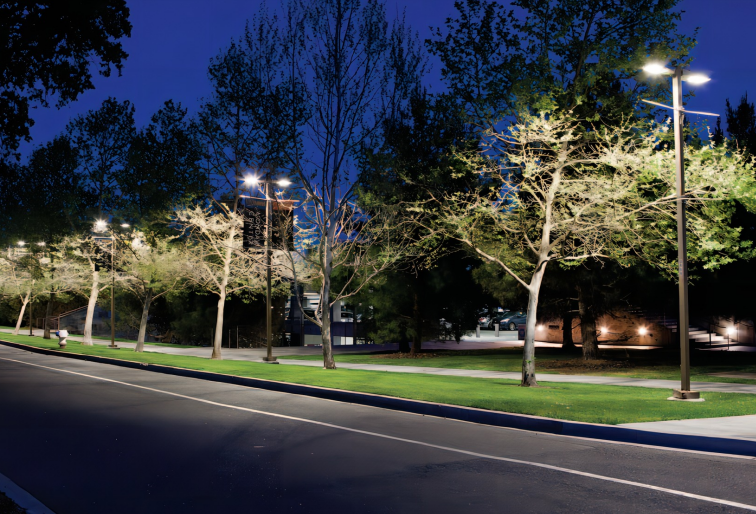
Parking lot lights that use LED technology have a great deal to live up to. Not only LEDs have surpassed previous lighting technologies in source efficacy, their size and directionality allow an LED luminaire to direct a greater percentage of light to the target area.
Lighting of outdoor areas had been previously dominated by high intensity discharge (HID) sources which include metal halide (MH) and high pressure sodium (HPS) lamps. Despite having a decent source efficacy, these omni-directional light sources that come as bulky glass bulbs are challenged with redirecting their luminous flux into a more useful and efficient distribution. HID parking lot lights generally are about 70% efficient at extracting the light produced by the lamp out of the luminaire.
Also, not all of the luminous flux from the luminaire is effectively utilized. A significant amount of the light that exits the luminaire concentrates around the rotation axis of the symmetric optical system and creates a hot spot which can cause visual discomfort. In contrast, the ratio of the total lumens exiting LED parking lot lights to the total lumens produced by the LEDs can be greater than 90%. The use of multiple discrete LEDs to form a light emitting surface (LES) allows the light to be evenly distributed across target area with an excellent max/min ratio (uniformity) of less than 3:1. High uniformity of lighting contributes to improved visual conditions and maximized fixture spacing.
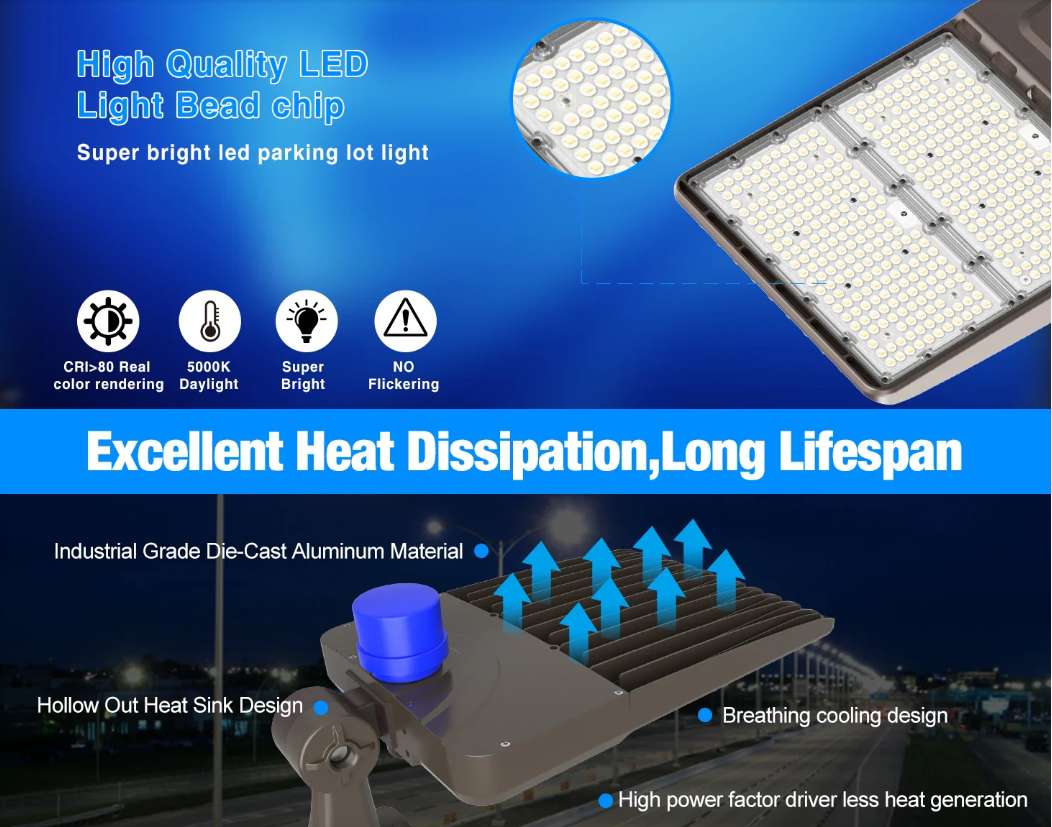
Excellent dimming and on/off switching capabilities open up tremendous opportunities for additional energy savings through integration with lighting controls and environmental sensors. While providing energy savings beyond improved source efficiency, the lion’s share of the return on investment (ROI) for switching to LED lighting is the maintenance savings from the use of LED systems with their extended lifetime.
Aside from the operational savings, LED lighting allows for optimization of the spectral composition to deliver high color rendering lighting and tailor the scotopic/photopic (S/P) ratio for a particular application.